Back to Index

Witness structures

// materials
mixed media
// Date
These three instances position ZhouKe within systems of witnessing, spectatorship, reflection, and circulation. HERD turns the protest image into a mirrored collective body. Fourth Wall transforms looking into an act of surveillance. @qiu_jin_ke extends the character into platform speech, where identity is performed, automated, archived, and repeatedly encountered. Together, they describe a condition in which seeing is never neutral. The viewer does not simply observe ZhouKe from outside the work. They are reflected by it, implicated in it, addressed through it, and drawn into the structures that allow the character to persist.
HERD
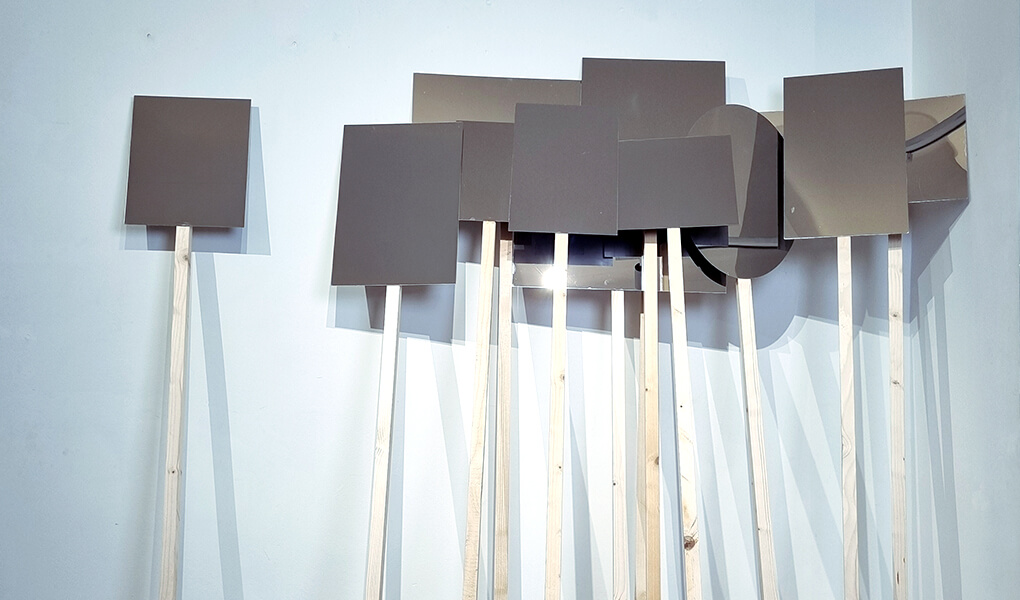
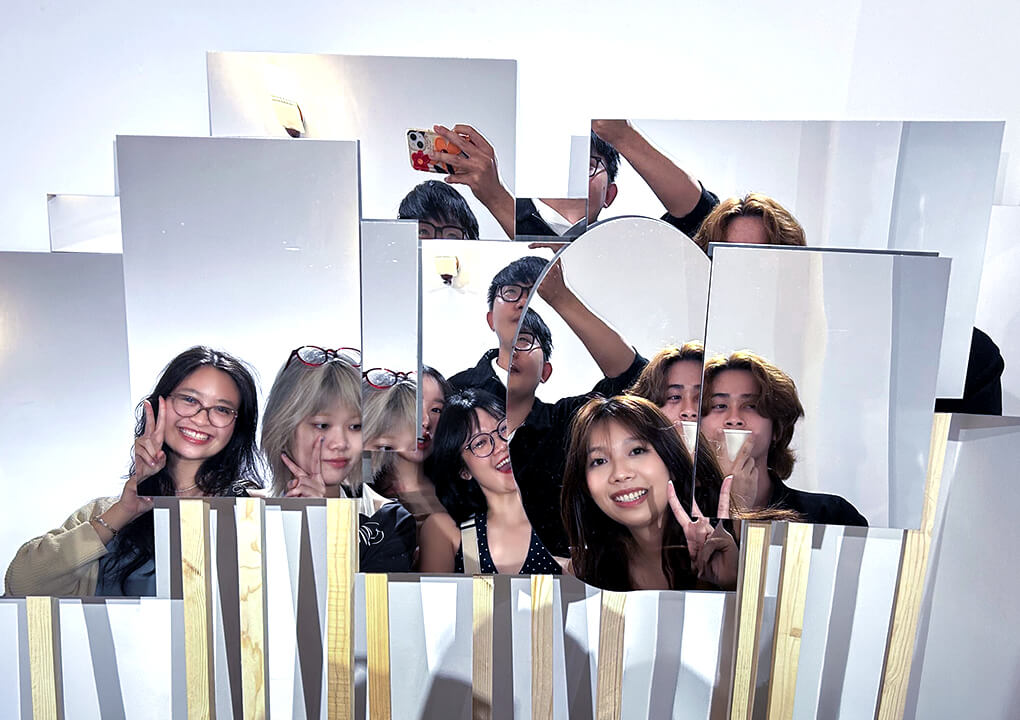
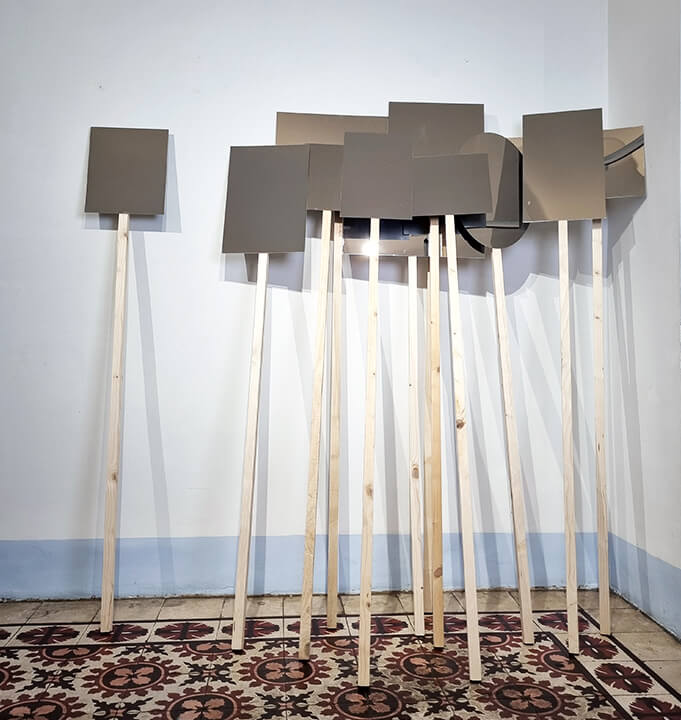
HERD gathers polished stainless-steel protest placards into a collective formation. Their mirrored surfaces return the viewer’s face, placing the spectator inside the image of public address before any slogan is spoken. The blankness of the placards is not empty. It holds the charged interval before language, where belief, performance, and group identity begin to form. The title carries an important ambiguity. A herd can suggest protection, movement, conformity, vulnerability, panic, or force. The work treats protest as both a necessary public act and an image increasingly shaped by circulation. Its reflective surfaces make participation unstable: the viewer appears inside the protest structure, but only as a temporary reflection, dependent on position, light, and proximity. Within ZhouKe, HERD extends identity from the individual figure to the collective body. The placard becomes object, image, surface, and latent instrument. It can carry language, protect a body, form a crowd, or become an aesthetic object absorbed by spectacle. The work holds that tension carefully, allowing protest to remain both politically charged and visually uncertain.
Fourth Wall
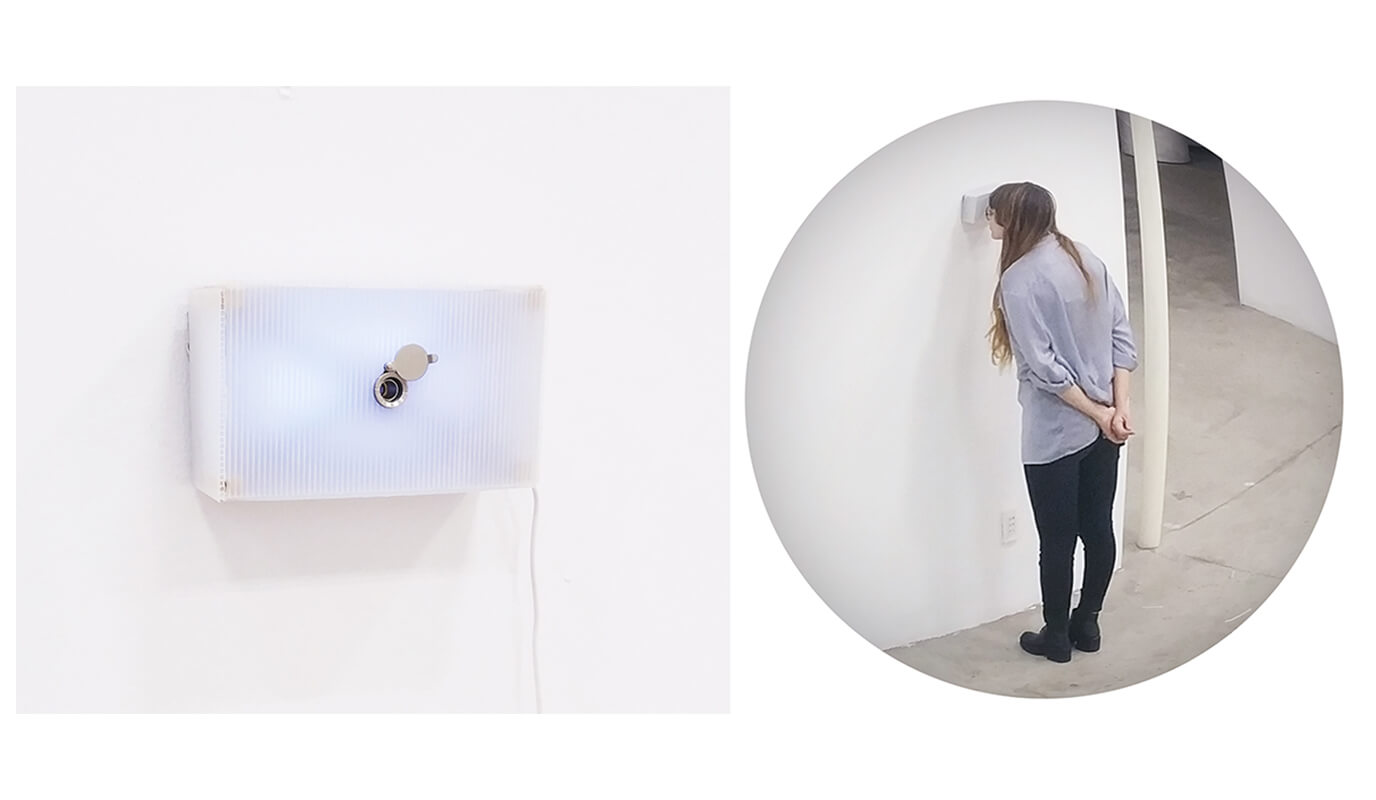
Fourth Wall begins with the simple act of looking. A peephole-like structure invites the viewer into a controlled visual situation, offering the illusion of access, secrecy, and privileged sight. Yet the work quickly shifts the terms of that encounter. Looking becomes a position inside an apparatus. In its VR form, the viewer no longer looks through the camera; the viewer becomes the camera. This reversal removes the comfort of distance. Surveillance is not presented as a remote system imposed from elsewhere, but as a mode of perception the body can temporarily occupy. The viewer is placed inside the mechanism they appear to examine. The title refers to the boundary between viewer and performance, but here that boundary is broken through surveillance rather than theatre. ZhouKe is watched, circulated, interpreted, and recorded, yet the viewer is also caught inside these same operations. Fourth Wall makes spectatorship active, implicating the act of seeing in the structures of visibility that produce the work.
@qiu_jin_ke
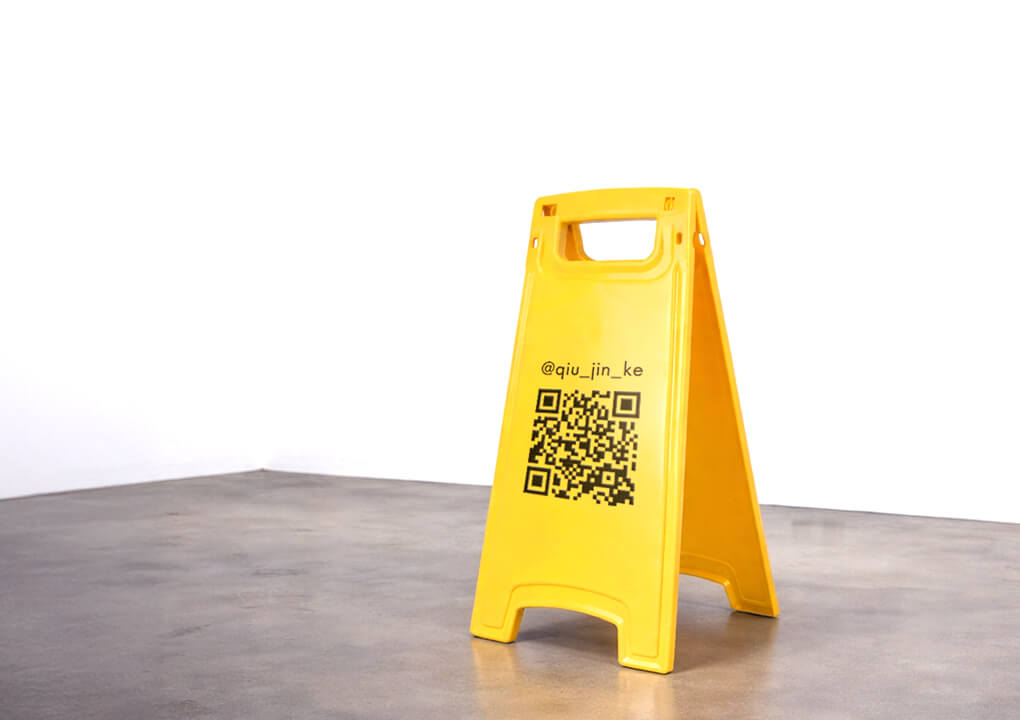
@qiu_jin_ke gives ZhouKe a networked voice. The Instagram account functions as an autonomous bot, producing fragments of poetry, commentary, and address through a platform built for image, performance, memory, and repetition. The name invokes Qiu Jin, the revolutionary feminist writer, while placing ZhouKe inside a contemporary system of automated speech and social circulation. The account is deliberately unstable. It can appear intimate, political, synthetic, sincere, staged, or mechanical. That uncertainty belongs to the medium. On social platforms, identity is never simply expressed; it is formatted through handles, captions, images, metrics, feeds, and the expectation of continuous presence. ZhouKe does not merely use the platform. She becomes legible through its conditions. As part of the larger sculpture, @qiu_jin_ke shifts authorship away from the singular hand. The character speaks through automation, cultural memory, censorship-aware language, and platform logic. The account becomes a living surface of the work, continuing beyond the gallery as a voice, trace, feed, and recurring signal.