Back to Index

Exhibition making

// materials
HCMC
Vietnam
// Date
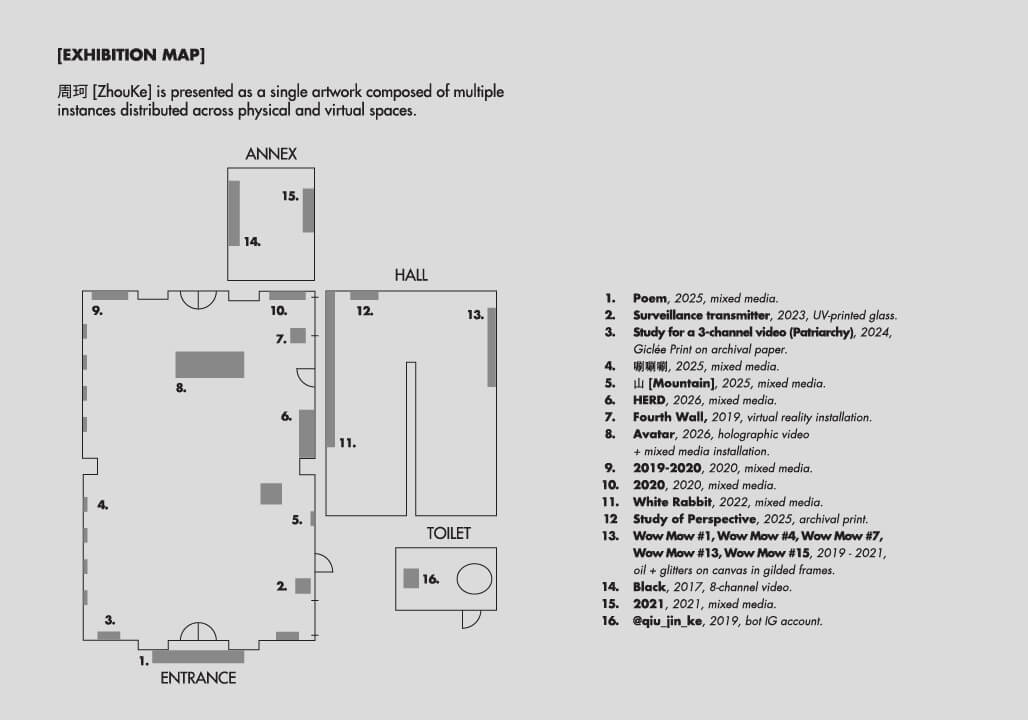
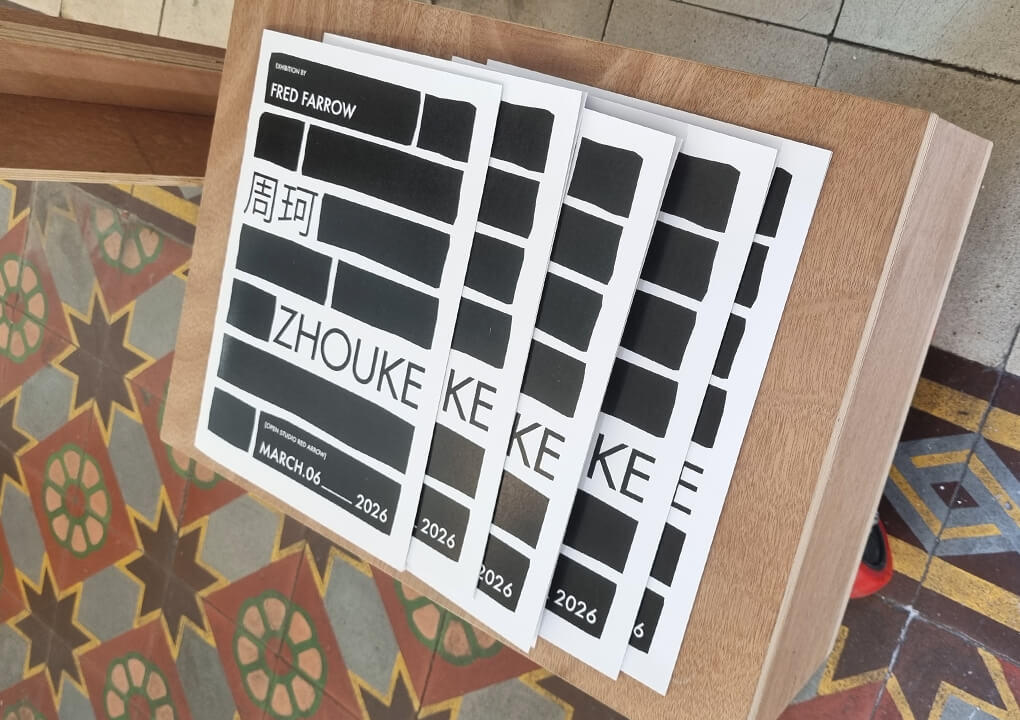
The exhibition is one spatial constellation of 周珂 [ZhouKe], a single metaphysical sculpture distributed across objects, images, bodies, interfaces, and networks. In this configuration, the gallery functions as the pedestal of the sculpture: the structure that holds the instances in relation and allows the work to become perceptible as one field. The instances shown in Ho Chi Minh City form a vocabulary rather than a fixed inventory. They give ZhouKe temporary shape through image, uniform, gesture, sound, projection, reflection, object, and digital trace. In another city, institution, or historical moment, this vocabulary may be rearranged, expanded, or partially replaced while still expressing the same identity. Like ZhouKe’s online voice, the sculpture is able to shift without losing coherence.
Constellation
The exhibition does not present autonomous works placed side by side. It composes relations. Each instance carries a fragment of ZhouKe’s structural identity, while the space determines how those fragments meet, interrupt, echo, and contaminate one another. Meaning is produced through proximity, interval, repetition, and movement. This makes curation an active sculptural operation. The placement of an object, the route through a doorway, the rhythm between screen and garment, the distance between a sign and a body, all become part of the form. ZhouKe appears through these decisions as much as through any single image. The HCMC exhibition should therefore be understood as one temporary arrangement of a larger work. It is a version, not a final composition. The sculpture remains capable of future configurations, where different instances may rise to the surface and others may recede.
Vocabulary
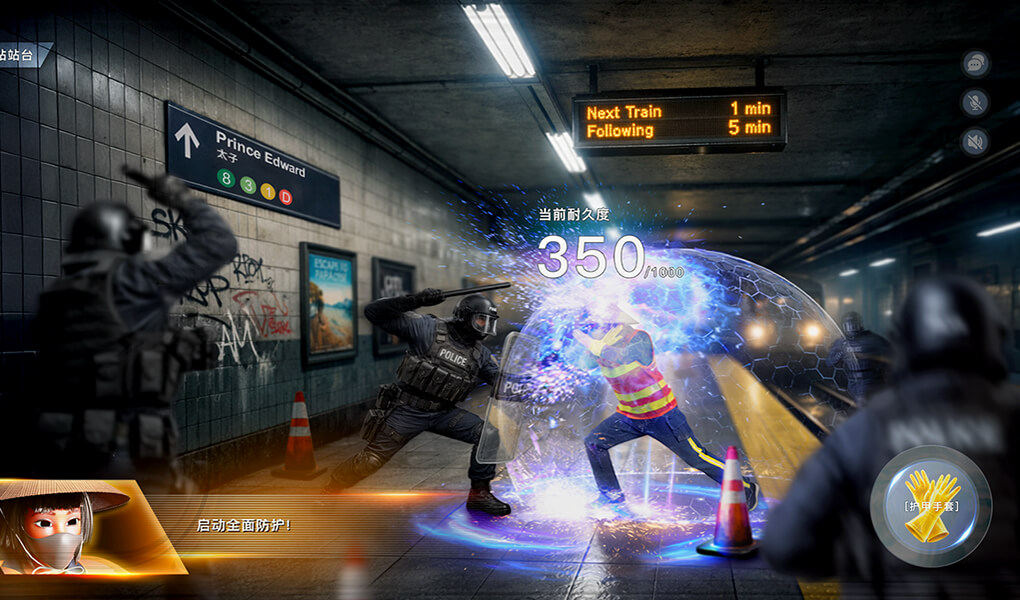
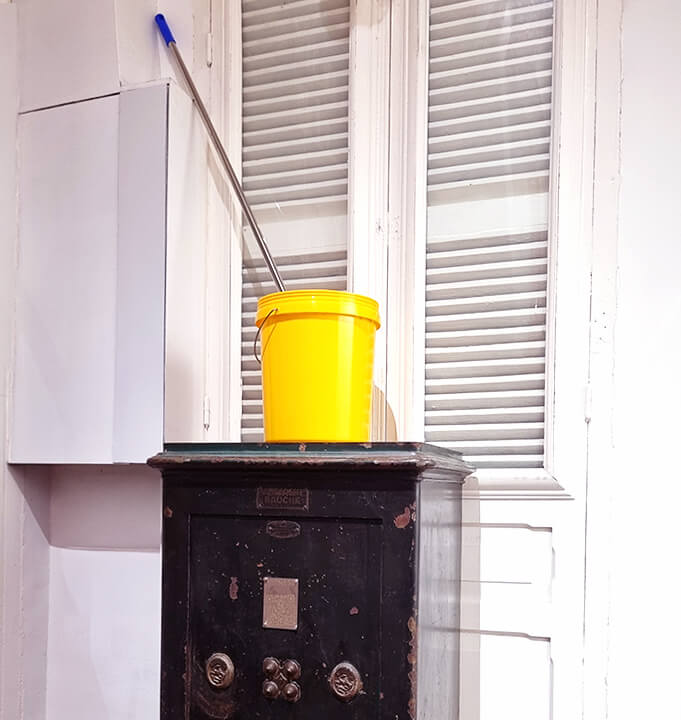
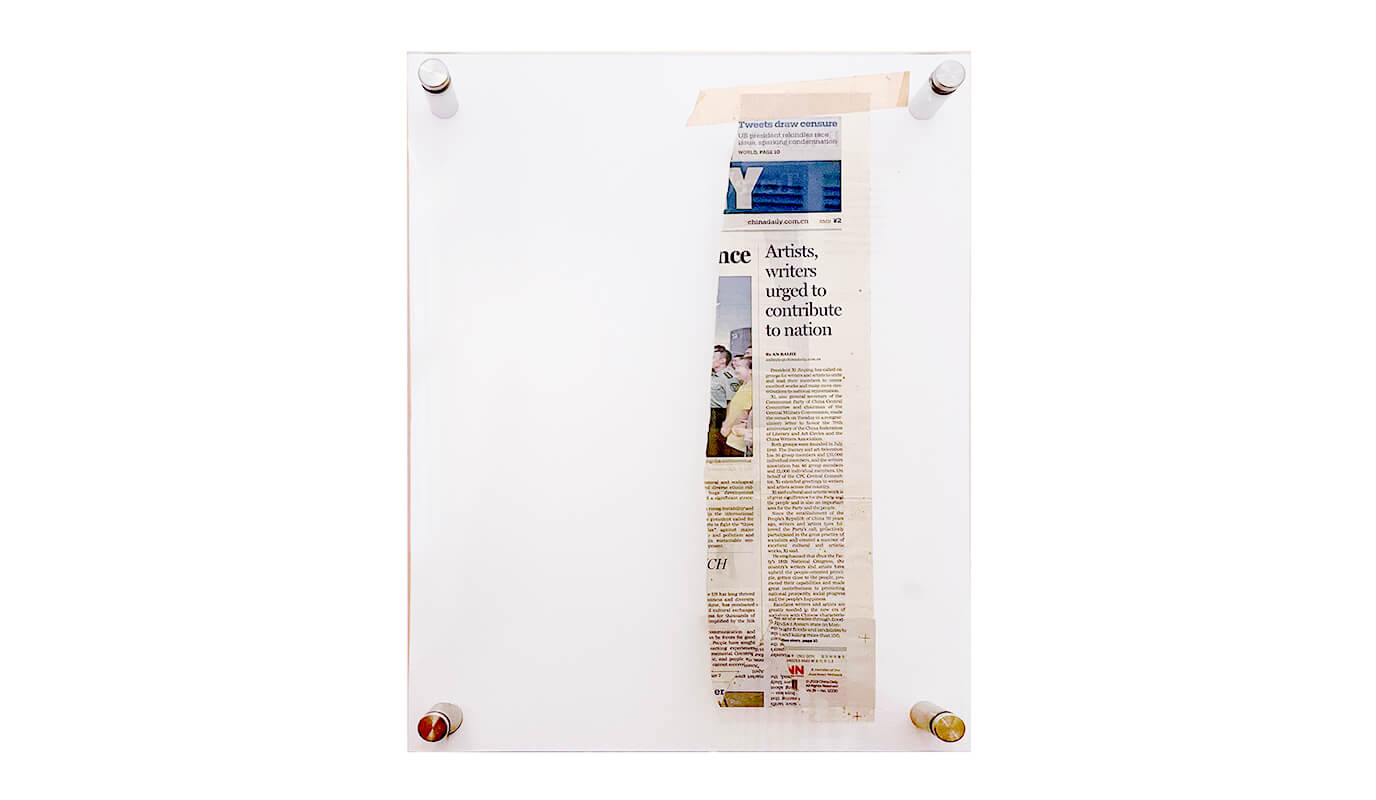
The objects are not props around a character. They are the grammar through which the character becomes legible. The uniform, mop, trolley, badge, sign, camera, bot, hologram, and reflective surface each operate as units of identity, forming a language of labor, visibility, control, humour, and transmission. Several instances were tested earlier in public or semi-public contexts, in the way a comedian tests material before a larger performance, or an author develops short stories before a novel. These tests were not peripheral. They allowed the structural function of the works to be measured: whether an image could hold, whether a gesture could travel, whether a sign could carry the pressure of the whole. Through this process, ZhouKe developed as a personality develops: by repetition, encounter, adjustment, and memory. The work did not arrive fully formed. It accumulated the logic of its own appearance.
Custody
None of the individual works in the exhibition were offered for sale. This was a deliberate sacrifice, especially as several objects attracted collector interest. The refusal was necessary to clarify that ZhouKe is not a group exhibition of related works, but a single sculpture whose parts operate as instances within a larger body. This decision also shifts the question of conservation. To conserve ZhouKe is not only to preserve objects. It is to preserve relations, instructions, permissions, digital traces, sequences, and modes of activation. The institutional role becomes closer to custody of a living score than ownership of a static object. In this sense, the work belongs to a lineage of practices where conservation includes reactivation, transmission, and fidelity to conditions rather than only material maintenance. The witness tokens extend this logic through networks. They record encounters, distribute the work’s memory, and help sustain the sculpture as a cultural structure beyond the exhibition site. ZhouKe is the first of Fred Farrow’s metaphysical sculptures. It proposes a form of sculpture in which space, image, technology, and social recognition become inseparable from the work’s material condition. The gallery gives the sculpture temporary weight, but the work is not exhausted by the gallery. The exhibition environment is therefore both stage and instrument. It allows ZhouKe to be encountered as a body of relations, while also revealing that the body can move, mutate, and return differently elsewhere. The sculpture persists through recognition, arrangement, and transmission. What remains after the exhibition is not simply documentation. It is the continuation of a structure: a set of images, gestures, objects, systems, and witnesses through which ZhouKe can be reassembled, remembered, and made present again.