Back to Index

"山 [Mountain]"

// materials
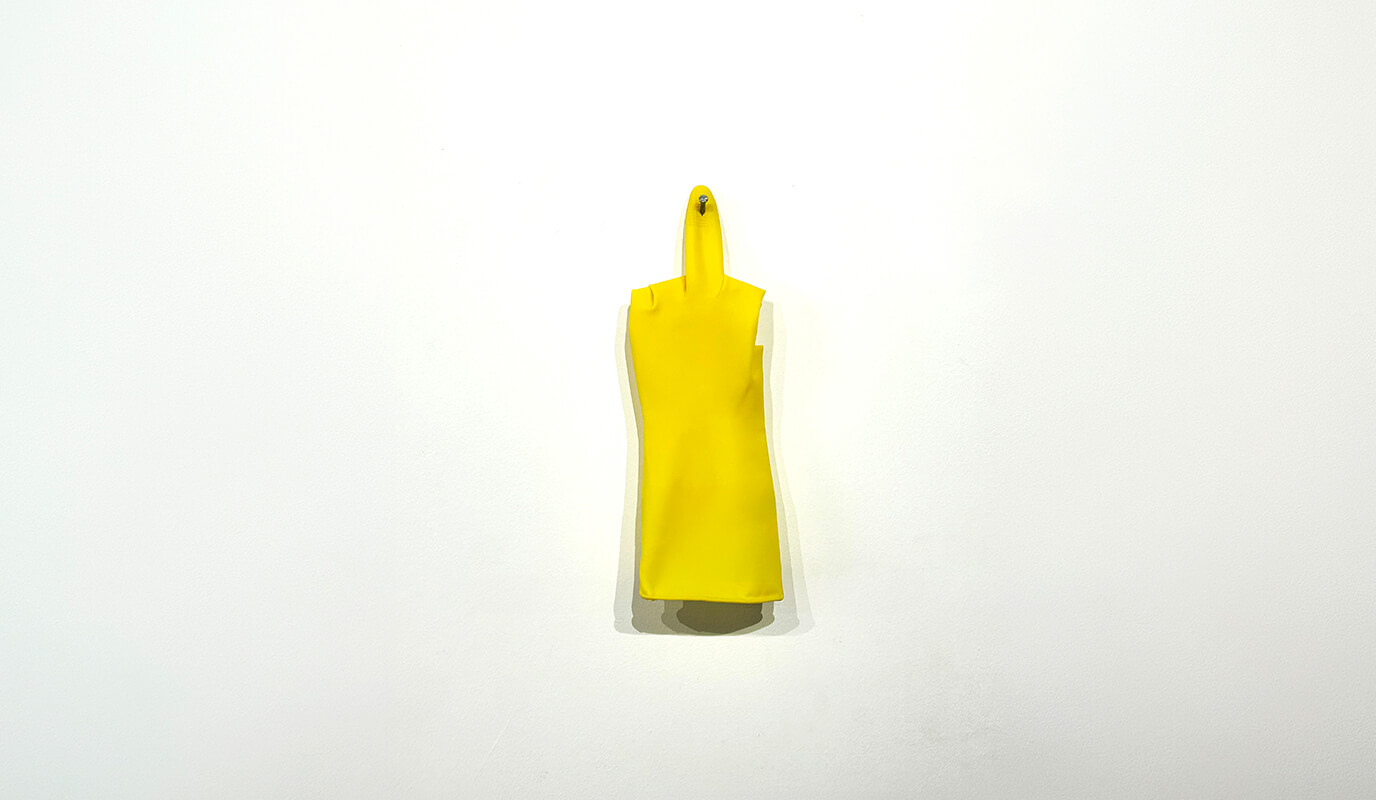
Stainless steel nail
Latex rubber glove
// Date
山 [Mountain] is spare and concentrated: a glove simply nailed to the wall, carrying a gesture that is immediately recognized and culturally learned. The work folds landscape, protest, authorship, and transmission into one small sign.
Meme
The title invokes mountain, with the shape of the glove evoking the shape of the Mandarin character. Landscape appears through orientation and symbolic weight rather than depiction. The glove becomes a remnant of action, an index of a body that has withdrawn, leaving behind a gesture in place of a view. The color and materiality of the functional cleaning accessory further establish the visual language of ZhouKe. The middle finger is a unit of cultural information. Its meaning is not natural, although it is often read instantly. It is learned, transmitted, repeated, and stabilized through recognition. In this sense the gesture functions like ZhouKe herself: a compact form that carries meaning because a culture has agreed, consciously or otherwise, to understand it.
Authorship
The idea for the work was generated by the ZhouKe bot and executed by the artist. This delegation gives the object its quiet charge. Authorship appears as a chain of instruction, interpretation, and material completion. The glove becomes a fossil of agency distributed between character, system, and hand.
May 35
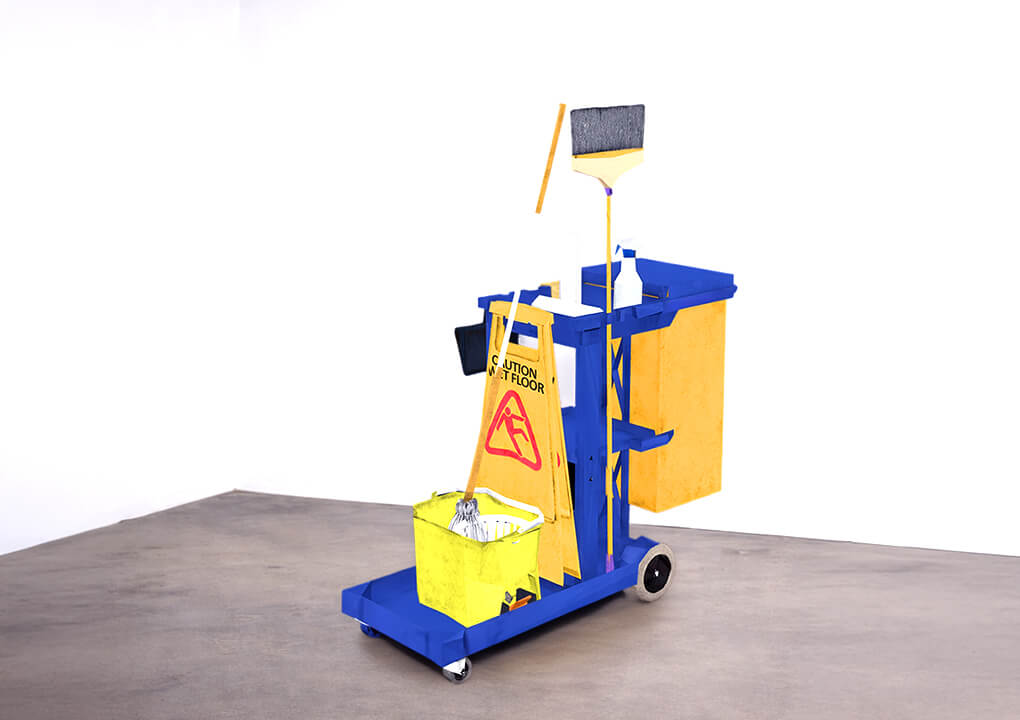
May 35 places a cleaning trolley into the exhibition through augmented reality. The viewer scans a QR code and sees the object appear in the room through the lens of a phone. The trolley is mundane, functional, and immediately recognizable, yet its configuration of buckets, handles, brushes, wheels, warning signs, and bright industrial colours gives it an unexpected sculptural clarity. It is a small architecture of maintenance. The title refers to an internet phrase used by netizens to speak around censorship of June 4, 1989, by extending the previous month beyond its official calendar. The work is not a representation of that historical tragedy. It focuses instead on the inventive linguistic and visual strategies that emerge under censorship. “May 35” becomes a compressed act of imagination: a date that does not exist, created so that memory can continue to circulate. Within ZhouKe, the cleaning trolley carries a double charge. It belongs to the character’s duty of cleaning, order, maintenance, and removal, while also pointing to the “cleaning” of the internet itself. The instance holds this tension without resolving it. Through AR, the object is both present and absent, placed in real space through a mediated device. Like ZhouKe herself, it exists through a lens, occupying the unstable territory between physical encounter, digital projection, and cultural memory.